3 Days to Liberation II
Part of the programme
3 DAYS TO LIBERATION II
(Statement and program)
12–14 December 2025
Conceived & curated by Maryam Palizban
Presented by CONSTANZA MACRAS / DORKY PARK
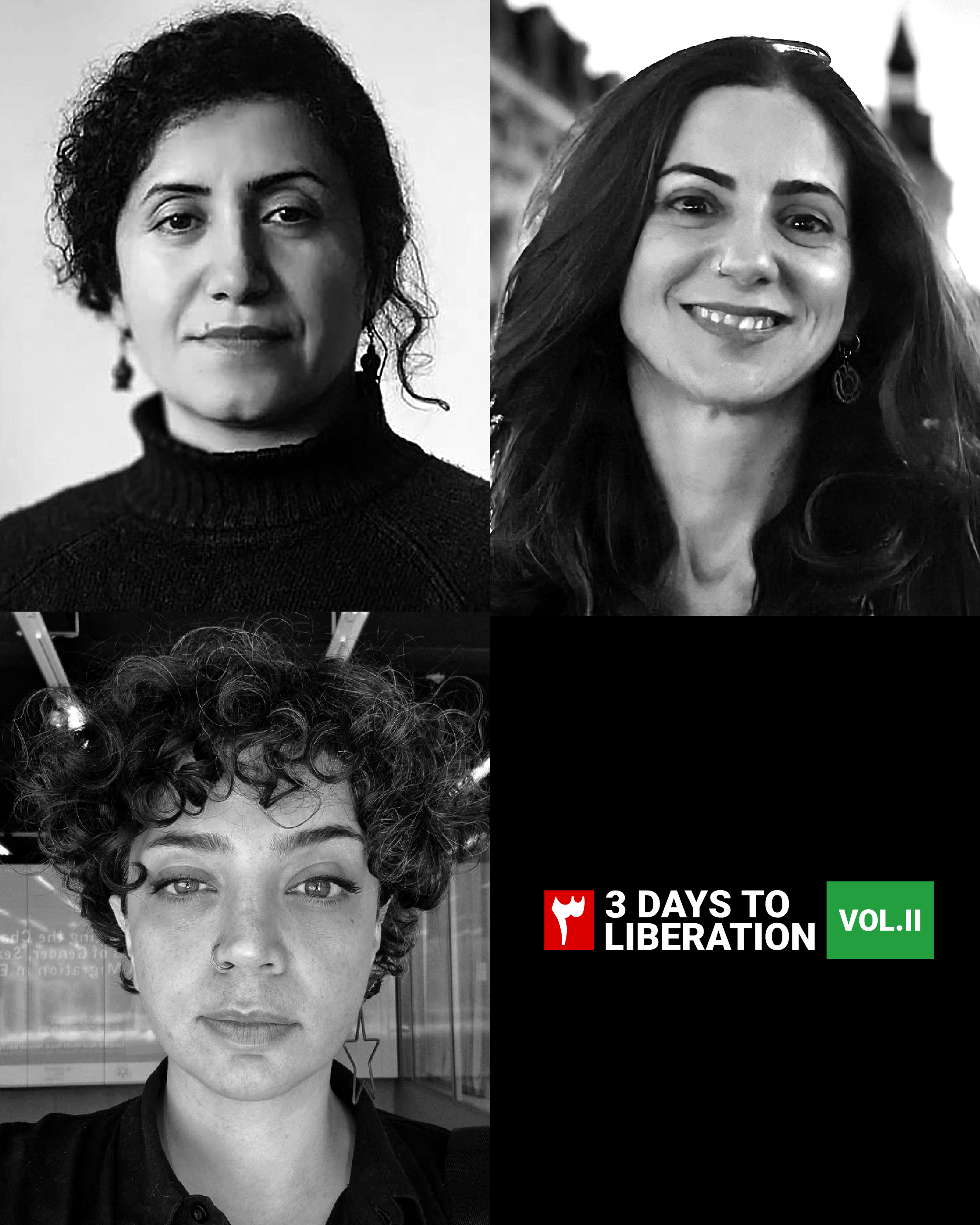
With: Fatemeh Karimi, Somayeh Rostampour
Moderator: Firoozeh Farvardin
What is active listening? It is not just a prerequisite for abstract analysis, but also a practical experience anchored in bodies, formed through songs, lists, and even burnt down archives. Those who listen enter a field of practice and resistance, of lived experience, remembrance and thinking. Fatemeh Karimi tells the story of the women of Komala—a leftwing Kurdish movement that emerged in Iran in the 1970s—as a complex practice in which fighting, caring, organizing, and theory building intertwined. They were pioneers of a special type of political participation in which women were recognized as fully-fledged subjects of resistance, and a such representatives of an early form of female political practice. Her work situates Komala in the political context of the 1979 revolution and its aftermath, as a chapter that highlights the need for critical reflection on gender relations in Iran and Kurdistan.
Somayeh Rostampour will take us to a different, yet certainly related place – the jineolojî ‘think tank’, a Kurdish variety of the “science of women” that stems from the practice of democratic self-government and female organization. Jineolojî is an open field in the becoming rather than a closed theory system. In an attempt to decolonize knowledge and challenge hierarchies, it seeked to create an epistemic vocabulary for livelihood and care contexts. The project always remained controversial. Rostampour highlights the tensions between academic criticism and jineological practice, and explores the legitimacy and the limits of a theory that emerged from violent struggles. It confronts us with the radical truth that women in armed movements do not act as a supplementary force of political processes, but as active creators of knowledge about bodies, mobility, care work, and collective organization. This knowledge is not theoretical, but material in nature – materialized in protocols, songs, decision-making processes, mourning lists, and so on.
For us, in our small and vulnerable space of encounter and exchange, this calls for a careful process of translation, not in the service of explaining, but in the service of preserving. Feminist knowledge is a lived and living practice, historically grounded yet effective in the present. It is in act of naming with open meanings; a kind of knowledge that is both resistance and theoretical system. On this panel, three researchers meet to explore the interconnections between gender, power, and resistance in Iran and Kurdistan. We focus on the books Women of Komala: Gender and Revolution in Iranian Kurdistan by Fatemeh Karimi (2025) and Femmes en armes, savoirs en révolte: Du militantisme kurde à la jineolojî by Somayeh Rostampour (2025). Together with Firoozeh Farvardin, the participants will discuss how academic research can become a space for resistance against forgetting, against political and epistemic violence. Participants are invited to discover this space between theory and experience, between political thought and lived history, as voices and knowledge in revolt.
Fatemeh Karimi is an activist and Kurdish researcher from Iran. She holds a PhD in sociology from the École des Hautes Études en Sciences Sociales (EHESS) in Paris. Since 2007, she has been researching Kurdish women in Iran, with a focus on the intersections of gender and ethnicity. She has published in Farsi, French, and English, on female genital mutilation (2010), polygamy (2014), and the political participation of Kurdish women in the 1980s (2022/2025). Apart from doing research, she works as a social worker.
Somayeh Rostampour is a feminist researcher and Kurdish activist. She holds a doctorate in sociology from Paris 8 University and specializes in social movements, gender issues, and minority rights, with a focus on Kurdistan, Turkey, and Iran. Special emphasis is put on the development and dissemination of theories and practices in feminist and revolutionary contexts in the Global South, particularly the Middle East. Her book Women in Arms, Knowledge in Revolt was published in 2025.
Firoozeh Farvardin is a sociologist and researcher at the Institute for Political Studies at the University of Vienna specializing in gender and politics in the context of authoritarian neo-liberal systems. She earned her doctorate with a thesis on the transformation of state and family politics in modern Iran from Berlin’s Humboldt University. She held postdoc scholarships as a fellow of the International Research Group on Authoritarianisman and Counter-Strategies (IRGAC) from Rosa-Luxemburg-Stiftung and of the Research Group Middle East (MERGE) at the Berlin Institute for Empirical Integration and Migration Research (BIM). Her work combines theoretical precision with an in-depth exploration of bodies, genders, and resistance in the Global South.
Panel: English

- 17.30Grüner Salon
3 Days to Liberation II
Kurdish Women – Gender, Resistance and Revolutionary Knowledge | Mit: Somayeh Rostampour, Fatemeh Karimi | Moderation: Firoozeh FarvardinPanel
